
Peptides have become one of the most searched topics in biotechnology, pharmaceuticals, regenerative medicine, and scientific research. Whether you’ve heard about peptides in drug development, laboratory research, or scientific publications, understanding what they are is the first step toward understanding their importance.
In this beginner-friendly guide, we’ll explain everything you need to know about peptides—from their basic structure to their applications in research and medicine—in simple language.
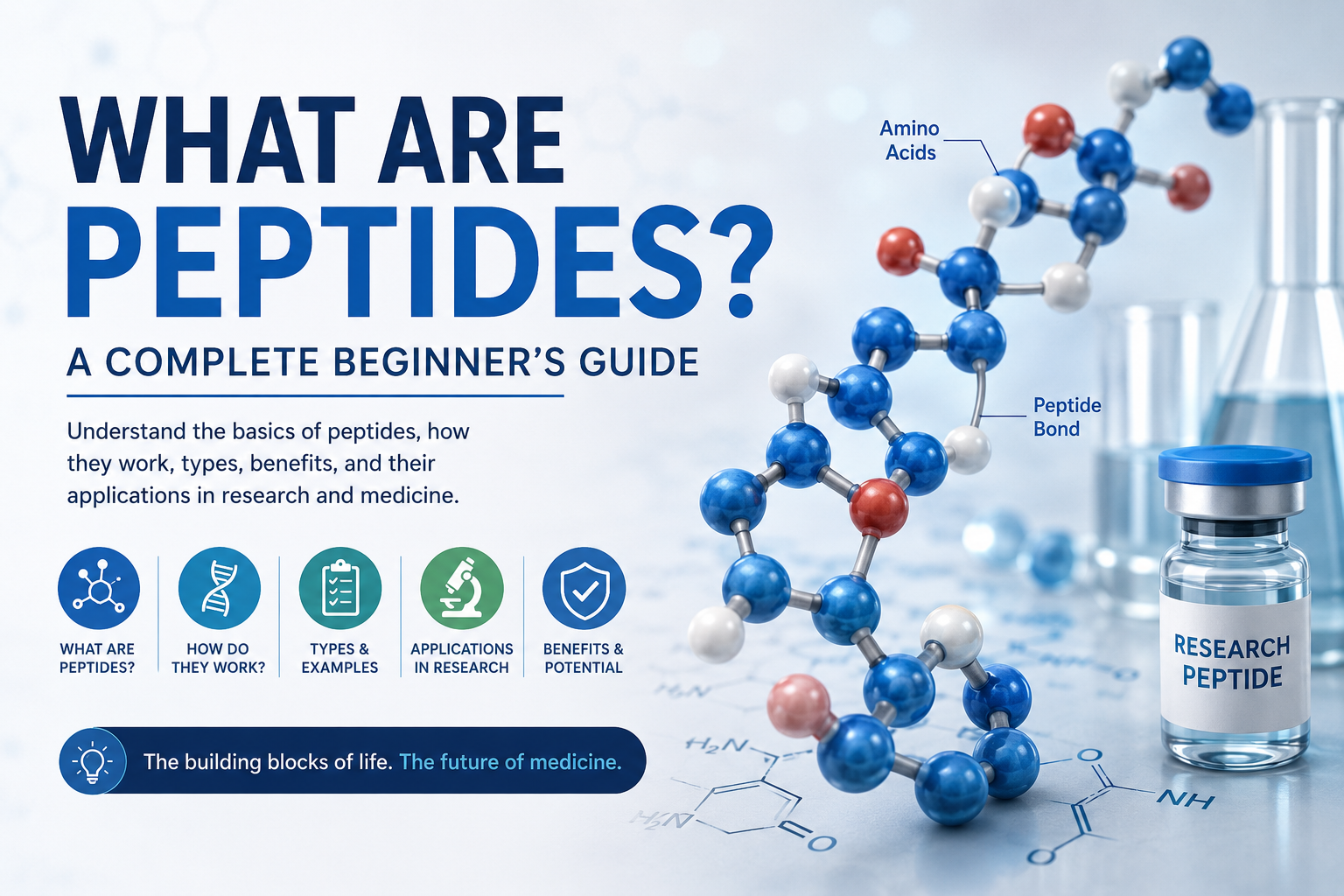
Peptides are short chains of amino acids connected by chemical bonds known as peptide bonds. Amino acids are the building blocks of proteins, and when between approximately 2 and 50 amino acids are linked together, they form a peptide. Longer chains generally form proteins.
Think of amino acids as individual beads. String a few together, and you get a peptide. String hundreds together, and you create a protein.
Your body naturally produces thousands of peptides that help regulate countless biological processes.
Although peptides and proteins are made from the same amino acids, there are important differences.
| Peptides | Proteins |
|---|---|
| Usually contain 2–50 amino acids | Usually contain more than 50 amino acids |
| Smaller molecular size | Larger molecular size |
| Often act as signaling molecules | Often provide structural or enzymatic functions |
| Easier to synthesize | More complex molecular structures |
Because peptides are smaller, they often interact with highly specific biological targets, making them valuable tools in biomedical research and pharmaceutical development.
Peptides function as biological messengers.
They bind to receptors on cells and trigger specific biological responses. Depending on the peptide, these signals may influence:
Rather than affecting multiple systems at once, many peptides are highly targeted, which is one reason they are widely studied in modern medicine.
Peptides play an essential role in almost every living organism.
Scientists continue to study peptides because they may offer advantages such as:
These characteristics have made peptide science one of the fastest-growing fields in biotechnology and pharmaceutical research.
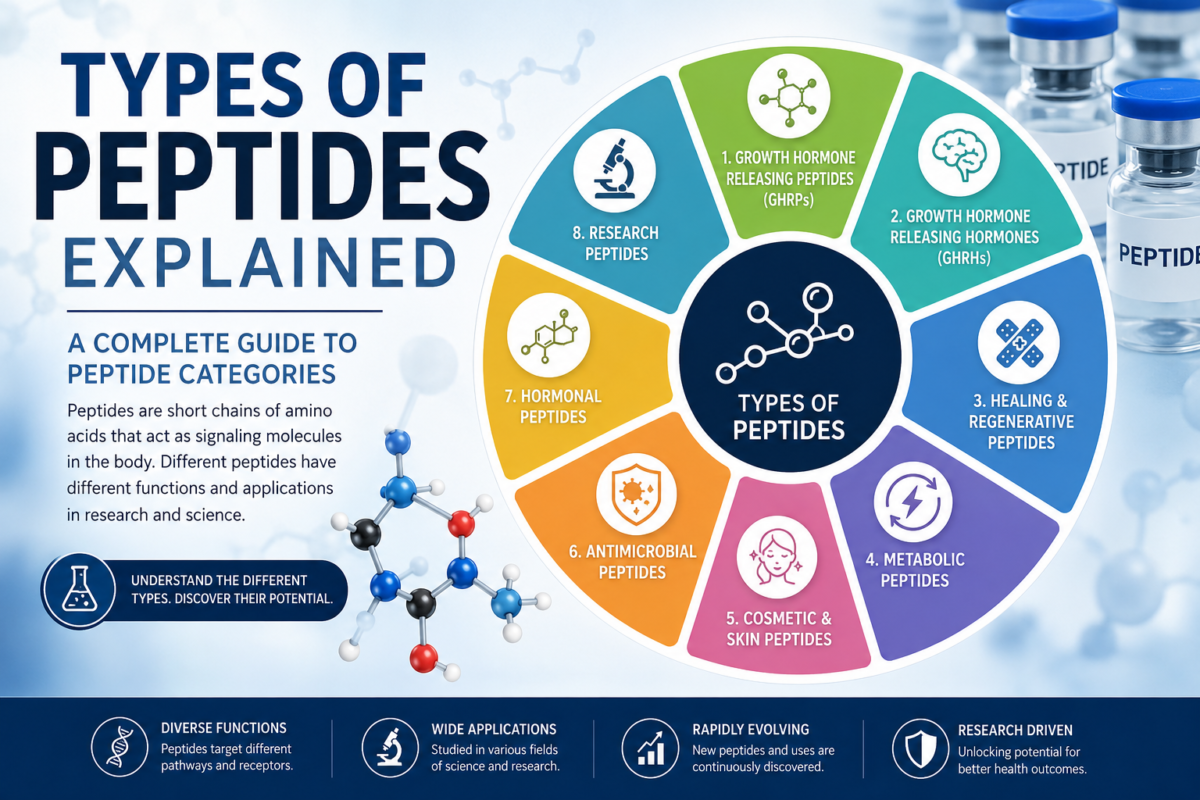
Peptides can be categorized based on their biological function.
These regulate physiological processes.
Examples include:
Many peptide-based medicines belong to this category.
These help transport newly synthesized proteins to their proper destinations inside cells.
Produced naturally by many organisms, these peptides help defend against bacteria, viruses, and fungi.
Researchers are investigating their potential role in combating antibiotic resistance.
Some peptides contribute to maintaining healthy tissues, including skin and connective tissue.
Collagen peptides are a common example used in nutritional and cosmetic products.
Numerous peptides are currently being investigated in laboratory settings for their biological properties and mechanisms.
These research compounds are studied in areas such as:
It is important to note that many research peptides remain under investigation and are not approved for general medical use.
These are produced naturally by living organisms.
Examples include:
Scientists can manufacture peptides in laboratories using advanced peptide synthesis techniques.
Synthetic peptides are commonly used for:
Peptides have applications across multiple scientific disciplines.
Many approved medicines are peptide-based, and researchers continue to explore new peptide therapeutics for a wide range of diseases.
Peptides are widely used in:
Scientists investigate peptides in fields including:
Certain cosmetic formulations include peptides that are intended to support skin appearance by promoting collagen-related pathways.
Researchers also study peptides for their potential roles in muscle physiology, recovery, metabolism, and exercise science. Many claims circulating online, however, are not supported by robust clinical evidence.
Some well-known peptides include:
Each peptide performs different biological functions and has distinct scientific or clinical relevance.
Researchers value peptides because they often provide:
Despite their potential, peptides also present challenges.
These include:
These challenges continue to drive innovation in peptide formulation and delivery technologies.
Safety depends on the specific peptide, its intended use, dosage, route of administration, and whether it has been approved by relevant regulatory authorities.
Some peptide medicines have undergone extensive clinical testing and are approved for medical use. Many others are still experimental and should only be studied within appropriate research or clinical settings. Users should be cautious of unsubstantiated marketing claims about investigational peptides.
Peptide science is expanding rapidly.
Researchers are exploring peptides for applications in:
As peptide synthesis technologies continue to improve, the role of peptides in biotechnology and pharmaceuticals is expected to grow significantly.
A peptide is a short chain of amino acids that acts as a signaling molecule or performs other biological functions within living organisms.
No. Peptides are shorter chains of amino acids, while proteins are generally larger and more structurally complex.
Yes. The human body naturally produces thousands of peptides that regulate various physiological processes.
Peptides are used in scientific research, biotechnology, diagnostics, pharmaceutical development, and approved medicines. Some are also used in cosmetics and nutrition.
No. While many peptide drugs are approved for specific medical uses, numerous other peptides remain investigational and are studied only in research settings.
Peptides are among the most important biological molecules in modern science. Their ability to act as precise cellular messengers has made them valuable in pharmaceutical research, biotechnology, diagnostics, and medicine.
As scientific understanding continues to evolve, peptides are expected to play an even greater role in the development of innovative therapies and research tools.
Whether you’re a researcher, healthcare professional, student, or simply interested in biotechnology, understanding peptide fundamentals provides an excellent foundation for exploring this rapidly growing field.