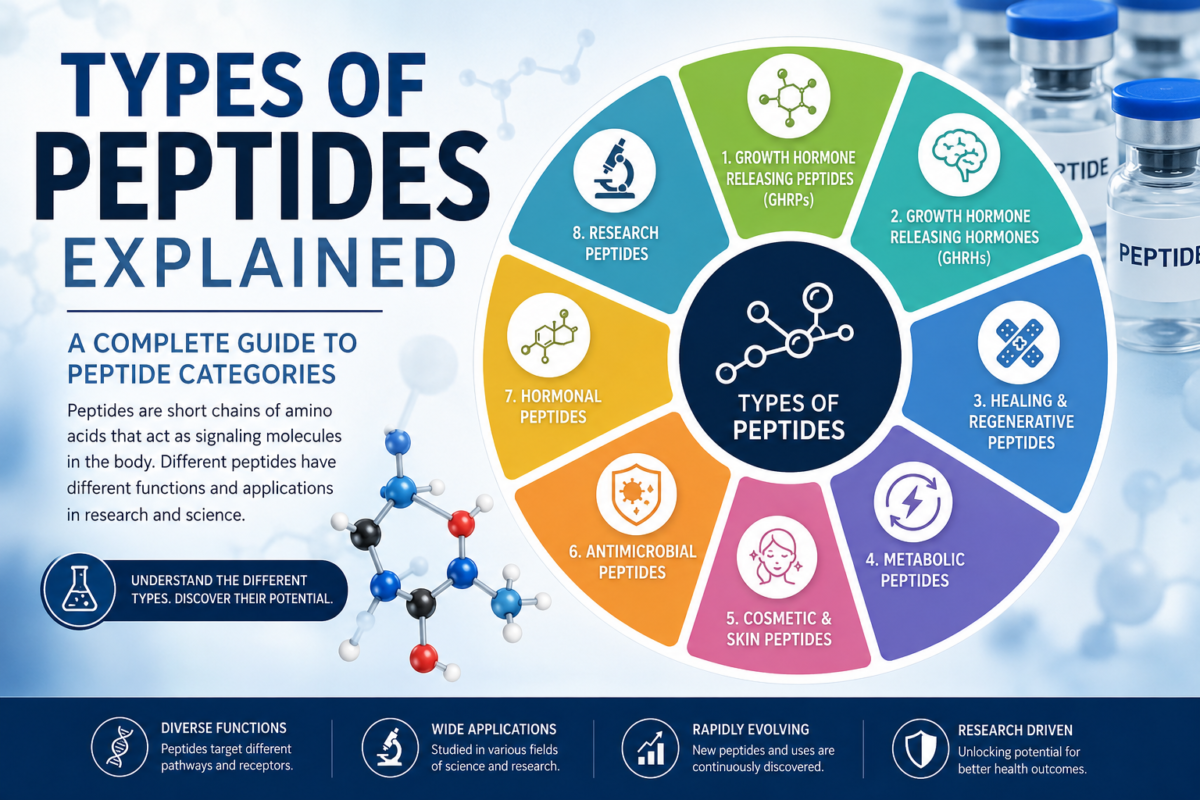
Peptides have become a central topic in sports science, endocrinology, and bodybuilding. Whether you are looking into muscle hypertrophy, fat loss, or recovery, understanding how these short chains of amino acids function is crucial before exploring their use.
This comprehensive guide breaks down what peptides are, their classifications, how specific growth hormone secretagogues work, their administration protocols, and key safety considerations.
In biochemistry, peptides are short chains of amino acids (typically between 2 and 50) linked by peptide bonds. They act as signaling molecules in the human body, binding to specific cellular receptors to instruct cells to perform targeted functions—such as releasing hormones, repairing tissues, or burning fat.
In a bodybuilding context, peptides are primarily used to:
To understand how different peptides behave, researchers categorize them based on their mechanism of action, cellular target, and functional structure.
                     ┌─────────────────────────────────────────┐
                     │          Peptides in Fitness            │
                     └────────────────────┬────────────────────┘
                                          │
        ┌─────────────────────────────────┼─────────────────────────────────┐
        │                                 │                                 │
┌───────┴────────┐               ┌────────┴────────┐               ┌────────┴────────┐
│  GHRHs         │               │  GHRPs          │               │  Fat Loss       │
│  (CJC-1295,    │               │  (GHRP-6,       │               │  Fragments      │
│   Sermorelin)  │               │   GHRP-2)       │               │  (Frag 176-191) │
└────────────────┘               └─────────────────┘               └─────────────────┘
GHRH analogs mimic the natural hypothalamic hormone that signals the pituitary gland to produce and release GH.
GHRPs stimulate GH release through a separate pathway by binding to the Ghrelin/Growth Hormone Secretagogue Receptor (GHS-R). Combining a GHRH with a GHRP produces a synergistic effect, resulting in a significantly larger GH pulse than either compound alone.
| Compound Category | Specific Peptide | Primary Mechanism / Purpose | Notable Characteristics |
| GHRH Analog | CJC-1295 | Extends natural GH release pulses | Often stacked with Ipamorelin or GHRPs for synergistic pulses. |
| GHRP / Ghrelin Mimetic | GHRP-6 | Stimulates pituitary GH release & appetite | Ideal during off-season bulking due to ghrelin-induced hunger stimulation. |
| GHRP / Ghrelin Mimetic | GHRP-2 | High-potency GH secretagogue | Stronger release than GHRP-6; mild influence on prolactin/cortisol. |
| Modified HGH Fragment | Frag 176-191 | Selective lipolysis / adipose reduction | Focuses purely on lipid metabolism and fat loss pathways. |
Peptides are delicate amino acid chains susceptible to heat, light, and mechanical stress. Proper handling is required to maintain bioactivity:
GHRHs (like CJC-1295 or Sermorelin) act on GHRH receptors to signal the production of growth hormone. GHRPs (like GHRP-6 or GHRP-2) act on ghrelin receptors to trigger a release pulse. When used together, they act synergistically to produce a significantly higher output than either used alone.
HGH Frag 176-191 is an isolated section (lipolytic domain) of the 191-amino acid HGH chain. It targets lipid metabolism and fat breakdown specifically, without causing insulin resistance or hyperglycemia, which full-spectrum HGH can induce.
Unlike synthetic anabolic steroids or exogenously administered high-dose HGH, secretagogues (like CJC-1295 and Ipamorelin) stimulate the pituitary gland to release natural GH in pulses. Consequently, they do not suppress the body’s natural endocrine feedback system in the same manner as exogenous hormones.
The legal status varies by country. Many peptides are restricted to research purposes or require specific medical prescriptions. Furthermore, secretagogues and growth factor fragments are strictly prohibited by the World Anti-Doping Agency (WADA) and major sports federations.
When evaluating research peptides, safety and quality assurance are paramount: