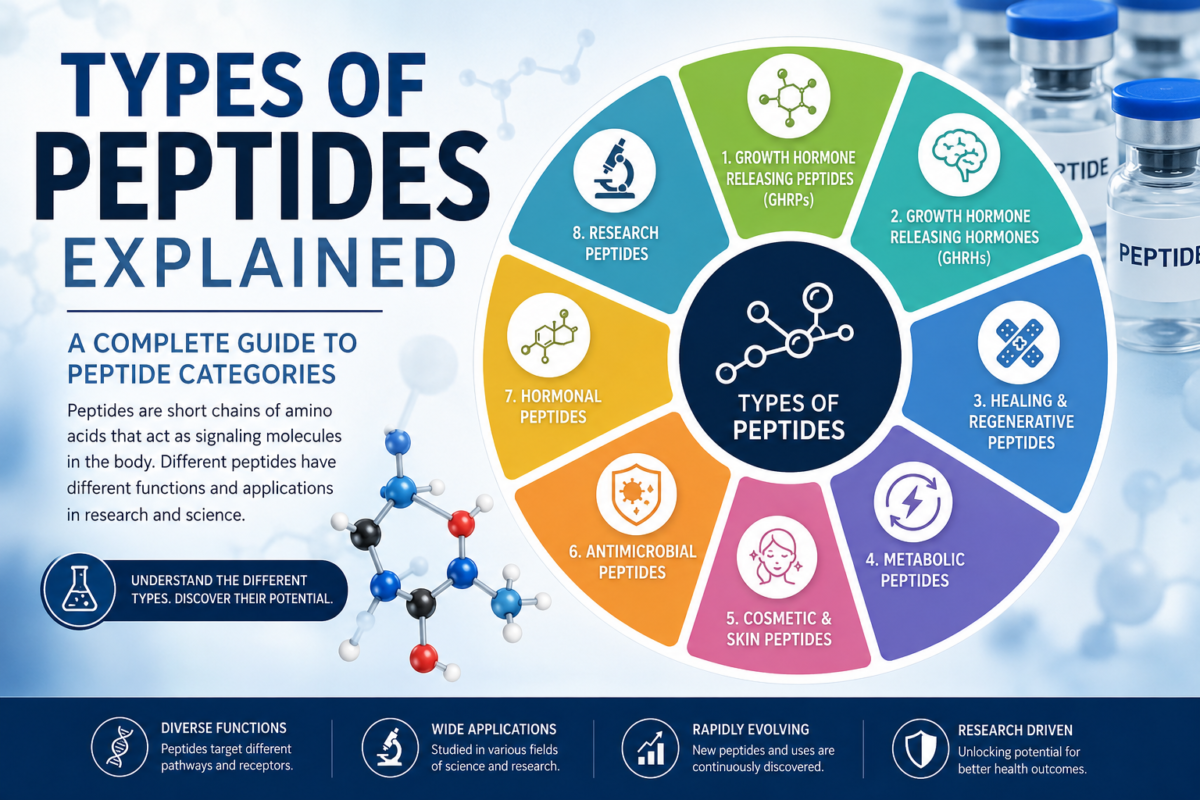

Peptides have rapidly evolved from a niche scientific topic into a powerhouse solution across dermatology, sports science, and anti-aging medicine. Whether you want to restore youthful skin, speed up fat loss, or optimize lean muscle recovery, understanding the types of peptides and what they do is key to making safe, informed choices.
In this comprehensive guide, we break down every major category—from topical skincare formulations to specialized injectable protocols.
What Are Peptides and How Do They Work?
At their core, peptides are short chains of amino acids connected by peptide bonds. Think of amino acids as individual building blocks:
-
Dipeptides & Tripeptides: 2 to 3 amino acids.
-
Oligopeptides: 4 to 20 amino acids.
-
Polypeptides: 20 to 50 amino acids.
-
Proteins: More than 50 amino acids (such as collagen or keratin).
Because peptides are smaller than full-length proteins, the body absorbs and processes them much more easily. In biological terms, peptides act as cellular messengers—signaling organs, tissues, and skin cells to produce specific hormones, repair damaged fibers, or trigger collagen production.
What Are Peptides in Skincare?
When introduced to topical dermatological products, peptides in skincare serve as targeted cell-signaling compounds. As we age, natural collagen and elastin breakdown leads to fine lines, wrinkles, and sagging skin. Applying specific peptides tricks the dermis into thinking collagen has broken down, triggering a cascade of fresh collagen and elastin synthesis.
Primary Types of Peptides in Skincare
-
Signal Peptides: These send chemical messages to skin cells to stimulate collagen, fibronectin, and elastin production.
-
Popular Examples: Palmitoyl Tripeptide-1, Palmitoyl Tetrapeptide-7 (found in Matrixyl 3000).
-
-
Carrier Peptides: These deliver trace minerals (like copper and manganese) directly to skin cells to accelerate wound healing and enzymatic repair.
-
Popular Examples: Copper Peptides (GHK-Cu).
-
-
Neurotransmitter-Inhibiting Peptides: Often referred to as “topical Botox,” these temporarily block chemical signals that cause subtle facial muscle contractions, smoothing out expression lines.
-
Popular Examples: Acetyl Hexapeptide-8 (Argireline).
-
-
Enzyme-Inhibitor Peptides: These work by preventing the natural degradation of collagen and matrix proteins caused by environmental factors and UV damage.
Types of Peptides for Weight Loss
Metabolic health and body composition therapy frequently leverage specific peptide formulations designed to influence appetite, insulin sensitivity, and fat oxidation.
| Peptide Category | Prominent Examples | Primary Mechanism |
| GLP-1 Receptor Agonists | Semaglutide, Tirzepatide | Delays gastric emptying, increases satiety, and regulates blood sugar levels. |
| Growth Hormone Secretagogues | AOD9604, CJC-1295 / Ipamorelin | Mimics the fat-burning (lipolytic) region of natural human growth hormone without affecting blood glucose. |
| Mitochondrial Peptides | MOTS-c | Regulates metabolic homeostasis and enhances cellular fatty acid oxidation. |
Different Types of Peptides for Muscle Growth & Bodybuilding
Athletes and fitness enthusiasts often turn to specific peptide stacks to support tissue repair, accelerate recovery times, and optimize lean muscle hypertrophy.
All Types of Peptides for Bodybuilding
-
Growth Hormone Releasing Hormones (GHRHs): Peptides like CJC-1295 and Sermorelin signal the pituitary gland to release steady pulses of endogenous Growth Hormone (GH).
-
Growth Hormone Secretagogues (GHSs): Compounds like Ipamorelin and GHRP-6 bind to ghrelin receptors to trigger natural GH release with minimal spike in cortisol or prolactin.
-
Tissue Repair & Recovery Peptides:
-
BPC-157 (Body Protection Compound): Highly regarded for accelerating tendon, ligament, and gut lining healing by promoting angiogenesis (new blood vessel creation).
-
TB-500 (Thymosin Beta-4 derivative): Enhances cell migration to damaged tissue sites, reducing inflammation and speed-tracking recovery from soft tissue injuries.
-
Types of Peptides for Women
While many peptides offer broad benefits across genders, certain formulations address physiological goals unique to women:
-
Skin Density & Anti-Aging: Copper peptides and palmitoyl peptides help maintain skin thickness and collagen density during hormonal shifts.
-
Hormonal & Body Composition Support: Ipamorelin paired with CJC-1295 helps manage abdominal visceral fat and supports lean body mass without androgenic side effects.
-
Sexual Wellness & Libido: Bremelanotide (PT-141) works directly on the central nervous system via melanocortin receptors to treat hypoactive sexual desire disorder (HSDD) in premenopausal women.
-
Bone Density & Joint Integrity: Recovery peptides like BPC-157 help protect connective tissue integrity and support joint elasticity.
Delivery Methods: Types of Peptides Injections vs. Topicals
The administration route depends heavily on the molecule size and the desired outcome:
-
Subcutaneous Injections: The most efficient method for systemic peptides (such as Semaglutide, Ipamorelin, or BPC-157). Administered into the fatty layer just beneath the skin using a fine needle to ensure high bioavailability.
-
Topical Creams & Serums: Ideal for localized skin concerns. Signal and carrier peptides penetrate the stratum corneum to deliver benefits directly to dermal layers.
-
Oral Capsules & Nasal Sprays: Formulations designed with protective buffers or stable peptide chains (e.g., stable oral BPC-157 formulations) for digestive or systemic absorption.
Summary Checklist: Selecting the Right Peptide
-
For Anti-Aging & Skincare: Look for Copper Peptides (GHK-Cu), Argireline, or Palmitoyl Tripeptide in daily serums.
-
For Weight Management: Discuss GLP-1 receptor agonists or fat-loss peptides like AOD9604 with a certified medical provider.
-
For Athletic Recovery & Lean Mass: Explore doctor-supervised protocols involving GHRHs (CJC-1295) and repair peptides (BPC-157).
Medical Disclaimer: Peptide therapies, particularly injectable variants, require careful clinical evaluation, prescription oversight, and baseline blood work. Always consult a licensed healthcare professional before starting any peptide regimen.