
n regenerative sports medicine and preclinical research, BPC-157 and TB-500 (Thymosin Beta-4 synthetic derivative) are two of the most widely discussed peptides for soft-tissue recovery. While both promote healing, they operate through completely distinct cellular mechanisms and target different aspects of the body’s repair cascade.
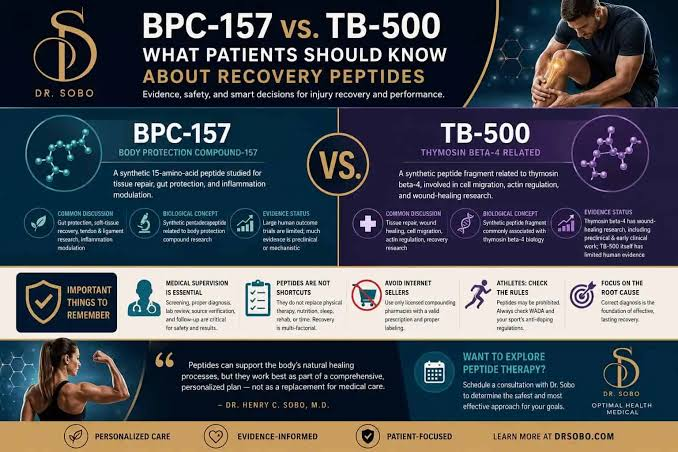
1. Mechanisms of Action: Side-by-Side┌──> Angiogenesis (VEGFR2) ───> Blood vessel growth in dense tendons [ BPC-157 Pathway ] ─────┼──> FAK-Paxillin Activation ─> Fibroblast migration & alignment └──> Growth Factor Response ──> Upregulates GHR on local tissues ┌──> Actin Sequestration ────> Cell motility & structural flexibility [ TB-500 Pathway ] ─────┼──> Systemic Circulation ───> Travels long-distance to injury sites └──> Anti-Fibrotic Signal ───> Reduces thick scar tissue formation
BPC-157 (Body Protection Compound-157)
Primary Function: Focalized angiogenesis, growth factor upregulation, and local connective tissue repair.
Cellular Mechanism:
Angiogenesis via VEGFR2: BPC-157 upregulates Vascular Endothelial Growth Factor Receptor 2 (VEGFR2) and stimulates the eNOS pathway, rapidly creating new micro-capillary networks in avascular or low-blood-flow tissues (like tendons, ligaments, and cartilage).
FAK-Paxillin Pathway: It activates Focal Adhesion Kinase (FAK) and paxillin, directing fibroblasts to migrate cleanly to damage sites and lay down structured Type I collagen parallel to natural fibers.
GHR Upregulation: It increases the density of Growth Hormone Receptors (GHR) directly on tendon fibroblasts, making localized tissue more responsive to circulating growth factors.
TB-500 (Thymosin Beta-4 Derivative)
Primary Function: Actin regulation, cell migration, flexibility restoration, and systemic tissue remodeling.
Cellular Mechanism:
G-Actin Sequestration: TB-500 is a synthetic peptide containing the active region (LKKTETQ motif) of Thymosin Beta-4. It binds to globular actin (G-actin), regulating cell structure, cell mobility, and tissue remodeling.
Cell Migration & Myocyte Repair: By controlling actin polymerization, it enables rapid movement of endothelial cells, keratinocytes, and myoblasts across longer anatomical distances to rebuild injured muscle fibers.
Anti-Fibrotic & Anti-Inflammatory: TB-500 suppresses excessive collagen cross-linking and downregulation of inflammatory cytokines (like TNF-alpha), helping prevent rigid, restrictive scar tissue in torn muscles or heart/lung tissue.
2. Head-to-Head Comparison Table
Attribute
BPC-157
TB-500
Origin / Nature
Derived from gastric juice protein
Synthetic fragment of Thymosin Beta-4
Primary Target
Tendons, ligaments, bone-to-tendon insertion, gut lining
Skeletal muscle fibers, heart tissue, skin, tendons
Key Cellular Driver
VEGFR2 upregulation, FAK-paxillin signaling
Actin regulation (G-actin sequestration), cell motility
Action Range
Predominantly localized / regional tissue response
Broad systemic distribution across larger muscle groups
Scar Tissue Impact
Promotes structured Type I collagen alignment
Prevents fibrotic adhesions and excessive scar formation
Complementary Role
Building blood supply & localized structural repair
Accelerating cell movement & muscle fiber remodeling
3. The Theoretical “Synergy” (Why They Are Combined)
In preclinical research and experimental protocols, researchers often study BPC-157 and TB-500 together because their mechanisms create a complementary dual-action healing loop:┌─────────────────────────────────────────────────────────────────────────┐ │ DUAL-ACTION SYNERGY │ ├─────────────────────────────────────────────────────────────────────────┤ │ BPC-157 : Builds micro-vessels & local blood supply (Roadways) │ │ TB-500 : Mobilizes cells & regulates actin for reconstruction (Vehicles)│ └─────────────────────────────────────────────────────────────────────────┘
Step 1: Establishing the Transport Network (BPC-157)
Injured tendons and ligaments cannot heal efficiently without oxygen and nutrients. BPC-157 builds the micro-vascular infrastructure (angiogenesis) directly around the injury zone.
Step 2: Mobilizing Repair Cells (TB-500)
Once capillary access is established, TB-500’s regulation of actin enables repair cells (endothelial cells and myocytes) to move across the tissue matrix into the site of damage.
Step 3: Quality Repair over Scarring
BPC-157 ensures new collagen fibers align along tension lines (preventing weak, brittle healing), while TB-500 suppresses fibrotic scarring, maintaining joint and muscle flexibility.
Regulatory & Safety Reminder
Clinical & Anti-Doping Status: Neither BPC-157 nor TB-500 is FDA-approved for human therapeutic use. Both substances are strictly prohibited under WADA Section S0 (Non-Approved Substances) for competitive athletes at all times (in and out of competition).