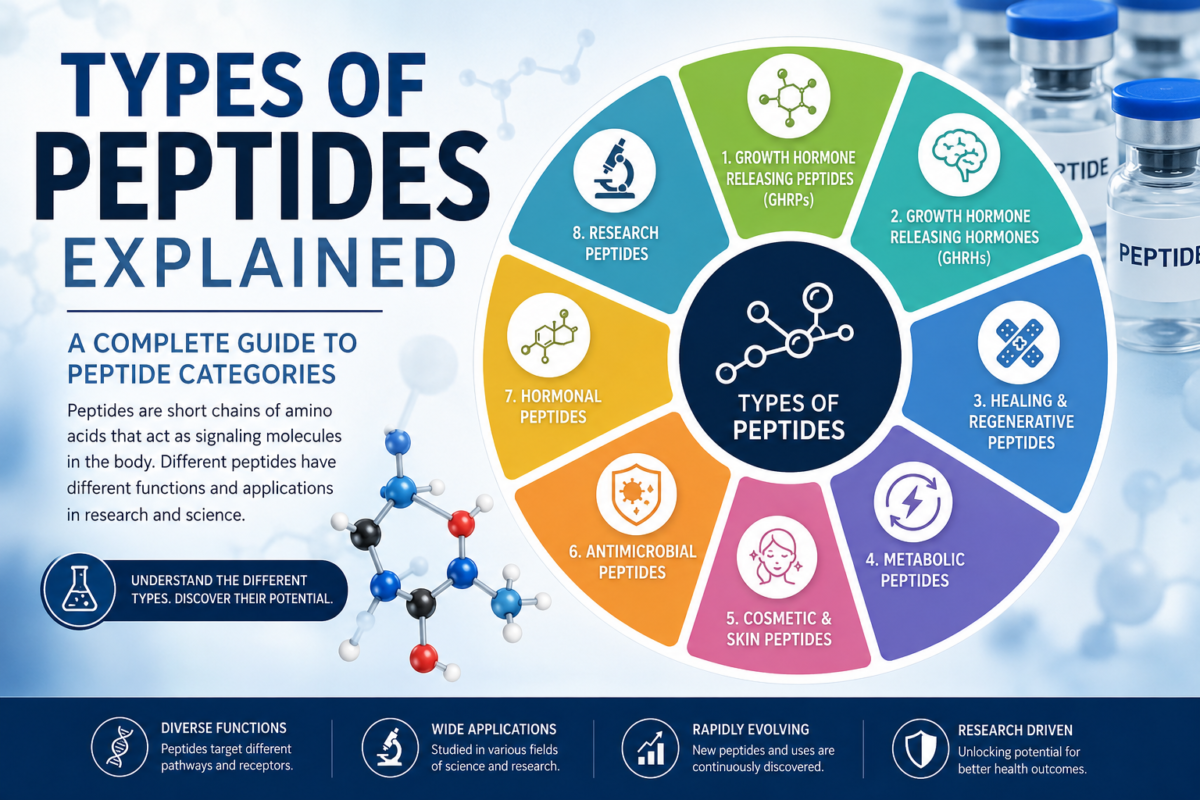
Peptides—short chains of amino acids ranging from 2 to roughly 100 residues—have become a central focus in modern biochemistry, clinical therapeutics, and wellness optimization. Unlike full proteins, which primarily serve structural or enzymatic roles, peptides act as high-specificity signaling molecules, binding to cell-surface receptors to trigger targeted physiological cascades.
With thousands of natural and synthetic sequences cataloged, understanding how many types of peptides exist and their functions requires organizing them by their primary biological activity rather than just their size.
Biochemists and researchers classify peptides based on origin, structure, and length, but for practical utility, they are categorized into six major functional classes. While nature produces over 7,000 distinct peptide sequences, current medical and scientific literature focuses on specific functional families.
These compounds influence inflammatory pathways, angiogenesis (blood vessel formation), and cellular migration to accelerate the recovery of soft tissues, tendons, and the gastrointestinal lining.
BPC-157: A 15-amino-acid gastric juice derivative studied extensively for gut health, ligament, and tendon repair.
TB-500: A synthetic fragment of Thymosin Beta-4 that promotes tissue remodeling and cell migration.
GHK-Cu: A copper-binding tripeptide that supports skin remodeling, collagen synthesis, and fibroblast activity.
Secretagogues stimulate the pituitary gland to release growth hormone (GH) in a pulsatile manner, supporting muscle protein synthesis, fat metabolism, and recovery.
Ipamorelin: A selective ghrelin receptor agonist that stimulates GH release with minimal impact on cortisol or prolactin.
CJC-1295 (without DAC): A Growth Hormone-Releasing Hormone (GHRH) analog that extends the half-life of natural GH pulses.
Incretin mimetics and metabolic regulators have transformed modern endocrinology and obesity management.
Semaglutide: A GLP-1 receptor agonist that enhances glucose-dependent insulin secretion and delays gastric emptying.
Tirzepatide: A dual GLP-1 and GIP receptor agonist offering enhanced glycemic control and weight reduction.
Retatrutide: A triple agonist targeting GLP-1, GIP, and glucagon receptors for maximum metabolic efficiency.
Derived from the mitochondrial genome, these peptides regulate cellular energy homeostasis, insulin sensitivity, and metabolic flexibility.
MOTS-c: A 16-amino-acid peptide implicated in fatty acid oxidation and metabolic adaptation.
Humanin: Researched for its cytoprotective properties under metabolic and oxidative stress.
Designed to cross the blood-brain barrier, these neuropeptides influence neurotransmitter systems, neuroplasticity, and anxiolytic pathways.
Selank & Semax: Synthetic analogs originating from tuftsin and adrenocorticotropic hormone (ACTH), studied for stress modulation and focus.
Dihexa: An angiotensin IV analog evaluated for brain-derived neurotrophic factor (BDNF) activation.
Topical peptides used in dermatology to signal skin cells to produce structural proteins.
Matrixyl (Palmitoyl Pentapeptide-4): Signals collagen I and IV production to improve skin elasticity and texture.
Argireline: Targets neurotransmitter pathways involved in facial muscle contraction.
| Peptide Class | Primary Mechanism | Target Application | Common Examples | Primary Delivery Route |
| Healing & Repair | Upregulates growth factor receptors & vessel growth | Tendon, gut, and soft-tissue recovery | BPC-157, TB-500, GHK-Cu | Subcutaneous injection / Topical |
| Secretagogues | Stimulates pituitary ghrelin/GHRH receptors | Growth hormone support, body composition | Ipamorelin, CJC-1295 | Subcutaneous injection |
| Metabolic | Activates incretin receptors (GLP-1/GIP) | Blood glucose management & weight loss | Semaglutide, Tirzepatide | Subcutaneous injection |
| Mitochondrial | Modulates cellular energy & fatty acid oxidation | Metabolic flexibility & insulin sensitivity | MOTS-c, Humanin | Subcutaneous injection |
| Cognitive | Interacts with central nervous system pathways | Focus, anxiolysis, and neuroplasticity | Selank, Semax | Intranasal / Subcutaneous |
| Cosmetic | Stimulates dermal fibroblasts & extracellular matrix | Skin anti-aging & barrier repair | Matrixyl, GHK-Cu | Topical serum/cream |
Navigating peptide protocols requires careful adherence to handling and pharmacological principles:
Enzymatic Degradation: Because native peptide bonds are vulnerable to peptidases found in the digestive tract, most therapeutic peptides cannot be taken orally (with rare exceptions engineered for stability). Subcutaneous injection, intranasal delivery, and topical application are standard alternatives.
Reconstitution & Storage: Lyophilized (freeze-dried) peptides must be stored away from heat and light, typically reconstituted using Bacteriostatic Water, and refrigerated to maintain structural integrity.
Regulatory & Quality Control: Pure research compounds differ significantly from FDA-approved peptide drugs. Sourcing requires strict analytical validation (HPLC testing and mass spectrometry verification).
Medical Disclaimer: This guide is for educational purposes only. Peptide protocols vary widely based on individual metabolic profiles, and clinical application should always be supervised by a qualified healthcare professional.